In our tradition we divide the year not only by eight solar and
agricultural holidays, but also by the Kalends. We celebrate twelve
months of the year by the common calendar, plus a special thirteenth
month for Samhain. These month cycles are associated with different
totemic spirits. Each month is assigned an animal, a bird (or other
flying creature), and a tree. May's totems are Cow, Hawthorn, and Bee.
The totemic associations are as follows:
Cow (Tarbh/Bò) – fertility, prosperity, protection, nourishment
Hawthorn (Huathe) – fertility, cleansing, protection, joy
Bee (Beach) – fertility, community, sweetness, celebration, organization
Bee
No
animal is a better example of the power of community than the bee. Each
bee in a hive has a specific function which she will perform even if it
means giving her life for the hive. There are three types of bees:
workers, drones, and queens. The worker bees are the common bees we are
most familiar with. They secrete wax to form combs, and produce honey
to feed the hive.
Bees pollinate all kinds of plants,
and many of our food crops would be useless without them. Because they
are the element that carries the reproductive pollen from one plant to
fertilize another, bees are strongly associated with fertility and
abundance.
Honey was anciently the only source for a sweetener. Thus, the bee has come to symbolize the sweetness of life.
Bees
communicate by dancing, and those who work with bees will find
themselves drawn to dance and rhythm. The bee's dance is indirect
relation to the sun in the sky. Bees are symbolic of solar celebration.
Honeybees will only sting if they feel that the hive is in danger. A honeybee gives its life when it uses its stinger.
The
queen of a hive is chosen from newly hatched bee larva when the hive
requires a new queen. In summer bees will swarm in search of a new
hive. The chosen queen will be fed royal jelly which will allow her to
become the sole reproducer in the hive. She will be attended by male
drones who give their life for mate with her.
When a
new coven of witches is formed from members of an older group it is said
that the new coven has “hived off”, just as swarming bees would gather
under a new queen.
Druids thought that the bee came
from the world of sun and spirit. They drank mead, a drink made from
fermented honey, to celebrate this connection.
Honey
and propolis, a resin which bees smear on their hives, are both
antiseptic and are wonderful would healers and preservatives. Thus,
bees have powerful healing magic.
All bees everywhere
build the combs in their hives at specific intervals of measurement.
This is known as “bee space”. If bees are prevalent in your life you may
need to examine if you are claiming the right amount of personal space
for yourself.
Finally, the bee's droning buzzing can be
compared to the sounds of otherworldly trance. Its hum is commemorated
in many folk names for the creature, including drumbee, drummer,
doombledore, hummabee, and humble-dad. In Welsh the word for harp,
tellinn, is a truncated version of the word for bee, an-tseillean.
Friday, October 21, 2016
Bellarmine Jars
A
Bellarmine jar is, by strictest definition, a brown ceramic bottle or
jug with a face depicted on its side, used by Witches for housing
spirits, hexing targets and removing curses or hexes. These jars were
very durable, and they were very, very popular among the west county
Witches of England because they would last, literally, for centuries --
protecting both their contents and the magic contained therein.
They weren't always known as Bellarmine jars, though. "Bellarmine" is a reference to an unpopular 16th Century Cardinal whose face appeared on the jars. Originally, though, these jars were manufactured in Frechen, near Cologne, in Germany. Here, they were called Bartmann jars -- "bearded man" jars, in reference to the bearded face who always appeared on the side.
Today, they are commonly called Witch Bottles, and the availability of a variety of materials used for bottling, canning and preservation means that contemporary Witches needn't use only brown crockery. Of course, the more durable and longer-lasting, the better. Glass might be the most popular of today's choices, but standard glass may not be your sturdiest alternative.
When creating a Bellarmine jar as a spirit house, the old, customary face can be a useful depiction of the spirit to whom you've provided a vessel. You can find potters and artisans who make contemporary versions of the old jars, or you can paint/carve/engrave your own.
Common contents of Bellarmine jars, for both spirit houses and curse/protection bottles, are hair, nail clippings, and charms/figurines. A spirit jar might also contain a few drops of blood and offerings related to the spirit housed within. A jar with the aim of both cursing and protecting might contain pins, broken glass, and urine. Sometimes the jar is buried in the yard with a warding chant such as follows:
They weren't always known as Bellarmine jars, though. "Bellarmine" is a reference to an unpopular 16th Century Cardinal whose face appeared on the jars. Originally, though, these jars were manufactured in Frechen, near Cologne, in Germany. Here, they were called Bartmann jars -- "bearded man" jars, in reference to the bearded face who always appeared on the side.
Today, they are commonly called Witch Bottles, and the availability of a variety of materials used for bottling, canning and preservation means that contemporary Witches needn't use only brown crockery. Of course, the more durable and longer-lasting, the better. Glass might be the most popular of today's choices, but standard glass may not be your sturdiest alternative.
When creating a Bellarmine jar as a spirit house, the old, customary face can be a useful depiction of the spirit to whom you've provided a vessel. You can find potters and artisans who make contemporary versions of the old jars, or you can paint/carve/engrave your own.
Common contents of Bellarmine jars, for both spirit houses and curse/protection bottles, are hair, nail clippings, and charms/figurines. A spirit jar might also contain a few drops of blood and offerings related to the spirit housed within. A jar with the aim of both cursing and protecting might contain pins, broken glass, and urine. Sometimes the jar is buried in the yard with a warding chant such as follows:
Into the ground go without fear
To guard me now both far and near
Throw back all evil from whence it came
By the Witchfather’s holy name
To guard me now both far and near
Throw back all evil from whence it came
By the Witchfather’s holy name
Incense Crafting
Incense
(from Latin incendere “to burn") is composed of aromatic natural
materials, which release fragrant smoke when burned. Incense can
generally be separated into two main types: “non-combustible incense"
and “combustible incense". Non-combustible incense is not capable of
burning on its own, and requires a separate heat source, such as a
charcoal. Combustible incense is lit directly by a flame and then fanned
or blown out, leaving a glowing ember that smolders and releases
fragrance. Direct-burning incense comes in several forms, including
incense sticks (or “joss sticks"), cones, and pyramids.
Resins (such as frankincense, myrrh, dragonsblood, etc.)
Oils (essential oils and high-quality fragrance oils are most desirable)
Wood or Roots (such as sandalwood, cedar chips, angelica, etc.)
Blossoms or Berries (these can be dried flowers, petals, or fruits)
In addition to the above list you may choose to add extra magical ingredients, such as ground gemstones, salt, nuts, honey, wine or juice, aromatic seeds, and magical powders or dirts.
You will want to consult a formulary or book of correspondences when you begin blending your own incenses for inspiration, magical associations, and health warnings. There are some traditional incense recipes that are made with dangerous or poisonous ingredients.
Keep record of the incenses you make in a personal formulary, so that you will remember the proportions and ingredients for your favorite blends. Store your incense in an airtight container and it will keep for at least a year. Incenses usually improve upon some aging (about two weeks) so that the different scents blend together. Burn your incense on a hot charcoal to release its fragrance and its magical properties.
NOTE - This article was originally published by Laurelei on the Blade and Broom blog.
Creating your own non-combustible incense
To create a long-burning complex incense which produces plenty of smoke and provides a good magical charge you will need to work from a formula of at least five different types of ingredients. You may add as many of each of the five ingredients as you choose, but there should be a minimum of one of each type in each incense you blend.The five types of ingredients are:
Herbs or Leaves (any dried fragrant botanical leaf or grass)Resins (such as frankincense, myrrh, dragonsblood, etc.)
Oils (essential oils and high-quality fragrance oils are most desirable)
Wood or Roots (such as sandalwood, cedar chips, angelica, etc.)
Blossoms or Berries (these can be dried flowers, petals, or fruits)
In addition to the above list you may choose to add extra magical ingredients, such as ground gemstones, salt, nuts, honey, wine or juice, aromatic seeds, and magical powders or dirts.
You will want to consult a formulary or book of correspondences when you begin blending your own incenses for inspiration, magical associations, and health warnings. There are some traditional incense recipes that are made with dangerous or poisonous ingredients.
Keep record of the incenses you make in a personal formulary, so that you will remember the proportions and ingredients for your favorite blends. Store your incense in an airtight container and it will keep for at least a year. Incenses usually improve upon some aging (about two weeks) so that the different scents blend together. Burn your incense on a hot charcoal to release its fragrance and its magical properties.
NOTE - This article was originally published by Laurelei on the Blade and Broom blog.
The Witches' Garter
The
magical garter has significance dating back to prehistoric times. Cave
art in eastern Spain that dates to the Paleolithic period shows a
sorcerer performing in a ritual while wearing nothing but a pair of
garters just below his knees.
In many traditions the garter is worn only by a Witch Queen, or Queen of the Sabbat. However, the traditional dress of Morris dancers consists of garters, usually red, and "Green Garters" is a traditional Morris Dancer tune.
In the trial recond of Margaret Johnson (Lancshsire 1633) the Devil was said to wear: "a suite of black, tyed about with silke pointes (garters)." If we take the position that the "Devil" was the Magister of the coven, then we see that the garter is not the sole province of the Queen of the Sabbat, but was also worn by men.
Red garters were said to be worn by a witchcraft coven Summoner. The Summoner's job was to advise members on meeting days and times. The red garters signified to others that s/he was genuine. Gerald Gardner used the red garters as a plot device to this effect in his novel about the witch cult, High Magic's Aid.
In some traditions the garter is prepared with green leather or velvet with a lining made of blue silk. In others the garter is made of red leather or snakeskin. There is usually one large, silver or gold buckle on the garter, representing the Queen's own coven, with additional, smaller, silver buckles for each of the other covens under her authority. The garter is worn on the left leg, just above the knee. It may be fastened with the large buckle or with silk ribbons.
Pennethorne Hughes states that when a tortured witch
was likely to reveal others, he or she may be murdered in jail by the
other witches to avoid further arrests and tortures. To prove that the
murder had been done under those circumstances, a garter would be left
tied loosely around the victim's throat. Such a potential informant
would be known as a "warlock," meaning traitor. The case of John Stewart
of Irving in 1618 is one such example. John Reid, of Renfrewshire in
1696, is another. Many legends and folk tales have a garter as the
leitmotif.
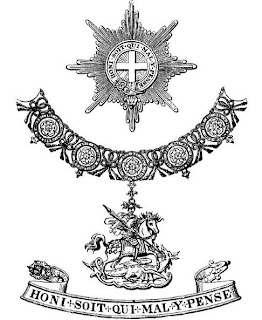
The Witch Garter is found in English history as being linked to the creation of the Order of the Garter. This order is Great Britain's highest and most ancient order of knighthood. The most widespread story states that the countess of Salisbury was dancing with King Edward III at a court function. As they danced, the countess's garter fell to the ground. The king picked it up and, to save her embarrassment, put it on his own leg with the words, "Honi soit qui mal y pense" (Shame be to him who thinks evil of it.") He went on to found the Order of the Garter, with that phrase as its slogan. The precise date for the founding of the order is not known, since the records have been destroyed, but it is thought to be 1344 or 1350. The most likely date, however, appears to be 1348.
Margaret Alice Murray mentions that it took more than a dropped garter to embarrass a lady in the 14th century, even a lady of the court. However, if the garter dropped was a ritual one, demonstrating that its owner was in fact a leader of the Old Religion, then there would be very real embarrassment, particularly since there were high personages of the Christian Church in attendance at the event. Edward's action, then, was incredibly smart thinking, for in placing the garter on his own leg, he not only saved face for the countess, but also proclaimed himself prepared to be a leader of the Pagan population as well as the Christian. This was a clever move taking into account that a large portion of his subjects were still Pagan at that point in time. Murray is puzzled by Edward's words, but if deemed as referring to the Old Religion itself, rather than the action or the garter, then they make very good sense. Edward then went on to form the Order of the Garter with twenty-four knights, himself, and the Prince of Wales-a total of twenty-six, or the number of two traditional covens. As Chief of the Order, the king wore a blue velvet mantle powdered over with 168 tiny garters. Along with the one on his leg, that made 169, or 13 times 13.
According to the Key of Solomon by Mathers this is the proper procedure for making magical garters:
HOW TO MAKE THE MAGIC GARTERS
TAKE enough of the skin of a stag to make two hollow tubular Garters, but before stitching them up thou shalt write on the side of the skin which was next the flesh the words and characters shown in Figure 8, with the blood of a hare killed on the 25th of June, and having filled the said Garters with green mugwort gathered also on the 25th of June before sunrise, thou shalt put in the two ends of each the eye of the fish called barbel; and when thou shalt wish to use them thou shalt get up before sunrise and wash them in a brook of running water, and place them one on each leg above the knee. After this thou shalt take a short rod of holm-oak cut on the same 25th of June, turn in the direction thou wishest to go, write upon the ground the name of the place, and commencing thy journey thou wilt find it accomplished in a few days and without fatigue. When thou wishest to stop thou hast only to say AMECH and beat the air with the aforesaid wand, and incontinently thou shalt be on firm ground.
*Note: This article was originally written by Laurelei for inclusion on the Blade and Broom blog.
In many traditions the garter is worn only by a Witch Queen, or Queen of the Sabbat. However, the traditional dress of Morris dancers consists of garters, usually red, and "Green Garters" is a traditional Morris Dancer tune.
In the trial recond of Margaret Johnson (Lancshsire 1633) the Devil was said to wear: "a suite of black, tyed about with silke pointes (garters)." If we take the position that the "Devil" was the Magister of the coven, then we see that the garter is not the sole province of the Queen of the Sabbat, but was also worn by men.
Red garters were said to be worn by a witchcraft coven Summoner. The Summoner's job was to advise members on meeting days and times. The red garters signified to others that s/he was genuine. Gerald Gardner used the red garters as a plot device to this effect in his novel about the witch cult, High Magic's Aid.
In some traditions the garter is prepared with green leather or velvet with a lining made of blue silk. In others the garter is made of red leather or snakeskin. There is usually one large, silver or gold buckle on the garter, representing the Queen's own coven, with additional, smaller, silver buckles for each of the other covens under her authority. The garter is worn on the left leg, just above the knee. It may be fastened with the large buckle or with silk ribbons.
![]() |
| Queens stitch garters, circa 1753. Wintertur Museum |
The Witch Garter is found in English history as being linked to the creation of the Order of the Garter. This order is Great Britain's highest and most ancient order of knighthood. The most widespread story states that the countess of Salisbury was dancing with King Edward III at a court function. As they danced, the countess's garter fell to the ground. The king picked it up and, to save her embarrassment, put it on his own leg with the words, "Honi soit qui mal y pense" (Shame be to him who thinks evil of it.") He went on to found the Order of the Garter, with that phrase as its slogan. The precise date for the founding of the order is not known, since the records have been destroyed, but it is thought to be 1344 or 1350. The most likely date, however, appears to be 1348.
Margaret Alice Murray mentions that it took more than a dropped garter to embarrass a lady in the 14th century, even a lady of the court. However, if the garter dropped was a ritual one, demonstrating that its owner was in fact a leader of the Old Religion, then there would be very real embarrassment, particularly since there were high personages of the Christian Church in attendance at the event. Edward's action, then, was incredibly smart thinking, for in placing the garter on his own leg, he not only saved face for the countess, but also proclaimed himself prepared to be a leader of the Pagan population as well as the Christian. This was a clever move taking into account that a large portion of his subjects were still Pagan at that point in time. Murray is puzzled by Edward's words, but if deemed as referring to the Old Religion itself, rather than the action or the garter, then they make very good sense. Edward then went on to form the Order of the Garter with twenty-four knights, himself, and the Prince of Wales-a total of twenty-six, or the number of two traditional covens. As Chief of the Order, the king wore a blue velvet mantle powdered over with 168 tiny garters. Along with the one on his leg, that made 169, or 13 times 13.
According to the Key of Solomon by Mathers this is the proper procedure for making magical garters:
HOW TO MAKE THE MAGIC GARTERS
TAKE enough of the skin of a stag to make two hollow tubular Garters, but before stitching them up thou shalt write on the side of the skin which was next the flesh the words and characters shown in Figure 8, with the blood of a hare killed on the 25th of June, and having filled the said Garters with green mugwort gathered also on the 25th of June before sunrise, thou shalt put in the two ends of each the eye of the fish called barbel; and when thou shalt wish to use them thou shalt get up before sunrise and wash them in a brook of running water, and place them one on each leg above the knee. After this thou shalt take a short rod of holm-oak cut on the same 25th of June, turn in the direction thou wishest to go, write upon the ground the name of the place, and commencing thy journey thou wilt find it accomplished in a few days and without fatigue. When thou wishest to stop thou hast only to say AMECH and beat the air with the aforesaid wand, and incontinently thou shalt be on firm ground.
![]() |
| Fig 8. "The Magick Garter" From the Key of Solomon |
Sunday, November 1, 2015
November Totems: Fox
In our tradition we divide the year not only by eight solar and
agricultural holidays, but also by the Kalends. We celebrate twelve
months of the year by the common calendar, plus a special thirteenth
month for Samhain. These month cycles are associated with different
totemic spirits. Each month is assigned an animal, a bird (or other
flying creature), and a tree. November's totems are Rowan, Raven, and
Fox.
The totemic associations are as follows:
FOX
Fox is credited with being a "cunning one" who is "strong in council." In nature, the fox is stealthy and clever. He knows when to stay hidden and when to come out into the open. Fox can teach you the discernment to know when to speak your mind and when to keep silent. Similarly, Fox teaches invisibility.
Fox is very intelligent, diplomatic, and charming. These qualities can be seen as sly and deceitful, though, when used dishonestly. Fox is often regarded as a trickster, for this reason.
He is "quick on his feet" and can teach you to make quick decisions and put them into action right away. He can also teach you to navigate obstacles quickly and decisively.
Fox is connected to Raven in this month's totems by virtue of them both being messengers who can access all Realms. Foxes can climb into the high branches of the trees (Upperworld), are astute navigators and runners on the ground (Middleworld), and dig dens below ground (Underworld).
Names for fox in different lands have been used by chieftains, princes, and advisers. Reynard means "strong in council," and Louernia means "son of Fox."
Foxes are usually red and white (or black and white) and are therefore linked to the three sacred colors. Animals with this sort of coloring were generally seen as sacred or special by the Celts, and fox fur has been discovered in princely or religious burial sites.
The totemic associations are as follows:
Fox – (Sionnach) trickster, invisibility, shape-shifting, diplomacy, wildness
Rowan – (Luis) protection against enchantment, psychic power, self-control
Raven – (Bran) underworld messenger, shape-shifting, trickster, initiation, protectionFOX
Fox is credited with being a "cunning one" who is "strong in council." In nature, the fox is stealthy and clever. He knows when to stay hidden and when to come out into the open. Fox can teach you the discernment to know when to speak your mind and when to keep silent. Similarly, Fox teaches invisibility.
Fox is very intelligent, diplomatic, and charming. These qualities can be seen as sly and deceitful, though, when used dishonestly. Fox is often regarded as a trickster, for this reason.
He is "quick on his feet" and can teach you to make quick decisions and put them into action right away. He can also teach you to navigate obstacles quickly and decisively.
Fox is connected to Raven in this month's totems by virtue of them both being messengers who can access all Realms. Foxes can climb into the high branches of the trees (Upperworld), are astute navigators and runners on the ground (Middleworld), and dig dens below ground (Underworld).
Names for fox in different lands have been used by chieftains, princes, and advisers. Reynard means "strong in council," and Louernia means "son of Fox."
Foxes are usually red and white (or black and white) and are therefore linked to the three sacred colors. Animals with this sort of coloring were generally seen as sacred or special by the Celts, and fox fur has been discovered in princely or religious burial sites.
Subscribe to:
Posts (Atom)


