Showing posts with label gandreigh. Show all posts

Saturday, October 22, 2016

The Three Realms


Sky, land, and sea,
Three-in-one, one-in-three.
~Celtic prayer

In most traditional cultures, people have viewed both the outer world and the inner planes are corollary concepts, where the macrocosm is a reflection of the microcosm, and vice versa. A great many of these cultures, including the ones from which the American Folkloric Tradition draws spiritual nourishment, see the Universe (both the inner and outer planes) as divided into three distinct realms of experience, wisdom, healing, and magic.

Worldwide, the Three Realms can be said to incorporate an Upper Realm (heavenly, celestial sphere), a Middle Realm (earthly, terrestrial sphere), and a Lower Realm (infernal, underworldly sphere). The beneficence or maleficence associated with these realms is dependent on the culture. Each has its own dangers and its own rewards. Each is inhabitant by its own sort of people, guarded by its own warriors, and ruled by its own leaders.

American folkloric practices draw most heavily from Celtic lore and Druidic practice. The Upper Realm is called Ceugent (ky-gent) and is an airy sphere of intellect, ideas,and future-sight. The Middle Realm is earthy Gwyned, which is the here and now, consensus reality. The Lower Realm is called Abred, and it is a watery realm of the subconscious, emotion, memory, and the past.
 
These realms are accessed spiritually through the use of shamanic trance techniques that generally incorporate the image of a World Tree or a Holy Mountain. Both of these images represent a concept called the Axis Mundi, the cross of the world. It is a nearly universally perceived spiritual and energetic construct. Carl Jung described this phenomena as the Collective Unconscious. It is also called the Consciousness Unit. However we define or describe it, shamans and witches have been going to the Tree or the Mountain since time immemorial to tap into the wisdom, insight, and healing that can be found within.

For purposes of spiritual travel (or "witch flight"), we use the image of the Spiral Castle (Caer Sidhe) spinning around to open its gate to the different points of the wheel of the year.  Its spire reaches up to the North Star, and its caverns are home to the great forge and the cauldron.  The pole is symbolized literally in our circles by the raising of the stang. By its virtue we can "ride" the stang to any place in the realms, though we may also use our own personal riding-pole, or gandreigh, to do so. Read more about the Stang and World Tree here.

Here are some associations for each of the three realms.

First Realm
Ceugent
Upperworld, Upper Realm
Realm of Sky, Wind, Otherworld
Struggle and enlightenment
Preservation: the undying realm, absence of decay
Birth, beginnings
The mind
Breath
Expansion/expansiveness
Perspective
Movement, setting in motion (beginning)
First arm of the Triskle
Spire of the Spiral Castle
Entry through flight or climbing
Metacognition
Black Knife/Athame

Second Realm
Gwyned
Earth world, Center world, Realm of Land, Middle Earth
Day-to-day struggles and concerns
Consensus reality, the here and now
Physicality
Living bones and flesh
Harsh realities
Progress, action, doing
Going through something
Middles
Limits and limitations (perceived and real)
Second arm of Triskle
Place of the Doorway of the Spiral Castle (and the Tor on which the Castle sits)
No entry needed (already in this realm)
Manipulation of perception/changing one's reality/glamory
Consciousness
White Knife/Kerfane-Bolline

Third Realm
Abred
Underworld, Realm of the Sea
Barrows, carins, caves
Initiation/Dragon chamber beneath the Tor of the Castle
Deep mystery
Truth beyond substance or thought
Emotion
Healing the soul
Rest
Death and preparation
Empathy
Blood, birth fluids, menses, semen, sweat
Oceans, lakes, ponds, pools
Inner self
Subliminal, Unconscious, Subconcious
Entry through caves, wells, etc.
Springs and wells bring energy/life from the third realm to the second
Third leg of Triskle
Red Knife/Shelg

Thursday, March 7, 2013

Seething

Seething is a literal translation of  Seiðr, which is a type of sorcery which was practiced in Norse society during the Late Scandinavian Iron Age.  Modern witches use seething as a way to shamanically get outside of themselves, into an altered state, and to raise the Power for charging a spell, tool, or talisman.

There are two modern interpretations of the practice of seething based on accounts in old Nordic sagas and other ancient literature.  The first method is very much like the practice of Treading the Mill.  The witch bears a gandreigh, or riding pole, such as a staff, broom, stang, hobby-horse, or wand.  He then treads a wide circle while focusing power on a central point, such as a stang, altar, or lead witch.  Alternately, the witch may choose to use their own gandreigh as the focal point and circle around it while holding it as the axis point.

The second method of seething is much more adaptable to any situation, although it may not be as historically accurate.  It entails the raising of great emotion and force of Will through the act of rocking back and forth, or clenching and unclenching the muscles of the body in rapid succession.  It is from this method that we gain the modern usage of the word “seething”, as in: “I was seething with anger”.

Anyone who has “zoned out” while relaxing in a rocking chair can understand how this method works.  By simple rhythmic control of the animal body the mind becomes free to wander as it will.  By adding a strong emotional component to the movement the mind keeps its focus on the magical work being done and the Power is raised.  This technique of seething is very similar to the Gardnerian Wiccan practice of ritual scourging to raise the power, as it both controls the blood flow and heightens the emotional state.

If a witch becomes proficient in this form of seething to raise the Power she may be able to seethe simply by controlling her breathing and clenching and relaxing certain muscle groups in the body.  This practice is very akin to raising kundalini, the serpent energy in the base of the spine.  Witches known about this serpent energy for ages, and it is thought by some researchers that the so-called Osculum Infame, or the kiss given to witches in fidelity to the Devil on his backside, was simply another way to raise this latent energy.

Tuesday, March 13, 2012

Widdershins, Sunwise, and Calling the Circle

Because we have set out to make this a family tradition, sometimes our daughter comes to us with questions that we have taken for granted.  Earlier this week she asked us about what widdershins means and what it is used for.
Widdershins (sometimes withershins, widershins or widderschynnes) means to take a course opposite the apparent motion of the sun, to go anticlockwise or lefthandwise, or to circle an object by always keeping it on the left.[1] The Oxford English Dictionary's entry cites the earliest uses of the word from 1513, where it was found in the phrase "widdersyns start my hair", i.e. my hair stood on end.

The use of the word also means "in a direction opposite to the usual", and in a direction contrary to the apparent course of the sun. It is cognate with the German language widersinnig, i.e., "against" + "sense". The term "widdershins" was especially common in Lowland Scots.

There are many groups that choose to work either exclusively widdershins -- especially those that tread the mill -- or its opposite, sunwise (also known as deosil).  
 In Scottish folklore, Sunwise or Sunward was considered the “prosperous course”, turning from east to west in the direction of the sun. The opposite course was known in Scotland as widdershins (Lowland Scots), or tuathal (Scottish Gaelic, lit. northerly), and would have been counterclockwise. It is perhaps no coincidence that, in the Northern Hemisphere, "sunwise" and "clockwise" run in the same direction. This is probably because of the use of the sun as a timekeeper on sundials etc., whose features were in turn transferred to clock faces themselves. Another influence may also have been the right-handed bias in many human cultures.

This is descriptive of the ceremony observed by the druids, of walking round their temples by the south, in the course of their directions, always keeping their temples on their right. This course (deiseal) was deemed propitious, the contrary course, tuathal, fatal, or at least, unpropitious. From this ancient superstition are derived several Gaelic customs which were still observed around the turn of the twentieth century, such as drinking over the left thumb, as Toland expresses it, or according to the course of the sun. Wicca uses the idiosyncratic spelling deosil - however, this is not used in any of the three Gaelic languages.

 We choose to tread the mill in both directions, depending on the nature of the rite.  We use the mill to lead us either up and out or down and within.  When treading sunwise, the energy rises upward spiraling us into the first realm, Ceugent. Treading widdershins brings the energy down into the land where we can access the third realm, Abred.  Neither of these movements is more desirable than the other, they are both as necessary and as benign as the positive and negative poles of a magnet.  

So, when casting the caim by calling in the gates and castles of the circle which way direction do we choose?  Many traditions call sunwise and dismiss widdershins, but we work the circle in a completely different pattern.

When casting the caim we call inward towards the Spiral Castle.  We call the gates and castles two-by-two to create the old straight track that joins each gate to the center like the spokes of a wheel. 

The circle is thrice cast, as of old, but by the power of the gates and guardians, not by the power of ourselves as casters.  The circle is cast not to hold energy out or even in, but to sain the space.

First we call to the realms, Ceugent above, Gwyned between, and Abred below.  This is the first circle. 

Next we call by honoring the station that the Spiral Castle is turned to in the year wheel.  Therefore, since it is now March as I write this, and the Spiral Castle is open to face the Spring Equinox, we would begin by calling the Castle of Revelry, acknowledging its treasure, the Golden Lantern, and its sovereign, the Golden Queen.  We would then call along the Path of the Queens across to the Castle Perilous, home of the Silver Queen and the Holy Grail.  We continue by calling along the Path of the Kings to the Stone Castle and the Glass Castle.  Each of these paths meet in the center at the stang, or Spiral Castle.  This is the second circle.

The third circle is that of the gates, or Airts, where we call to the four elemental quarters and the Great Gods of our Tradition.  We call to the White Goddess and the Black Goddess through the South and North gates, homes of Earth and Air.  This is the Path of the Rose-Painted Wagon, which is a mystery.

We then call along the Path of the Sun, East to West, dawn to twilight, the road of Tubal Cain.  In the East shines Lucifer/Malek Taus/Azazel, light-bringer, lord of creation and inspiration.  Tubal Cain stokes the forge and the sun rises, the cunning fire rises, the light of reason rises.  Fire blazes forth from the Eastern gate, filling us with warmth and force of Will. 

We echo that calling to Tubal Cain in the West, Lord of the quench tank.  Here Tubal Cain is the Dark Lord of Death and Magic, who peacefully shepherds those beyond the veil, and raucously leads out the Wild Hunt.  He comes from the Western gate, place of Water, land of the setting sun, place of the Blessed Isle of Avalon.  Here lies the weapon of the helm, the mask, the Helkapp by which Death comes silent and invisible.

Thus is the third circle cast. 

Together the three circles, sending out rays in all directions: above and below, north and south, east and west, and all places between, build the Spiral Castle, the stang which we use as a gandreigh to travel out to each of the realms, and all of the places between.

By treading the mill sunwise or widdershins we can travel out or send forth energy to wherever and whenever we choose, guarded by our Gods, and the Watchtowers of legend.

Monday, February 20, 2012

The Gandreigh

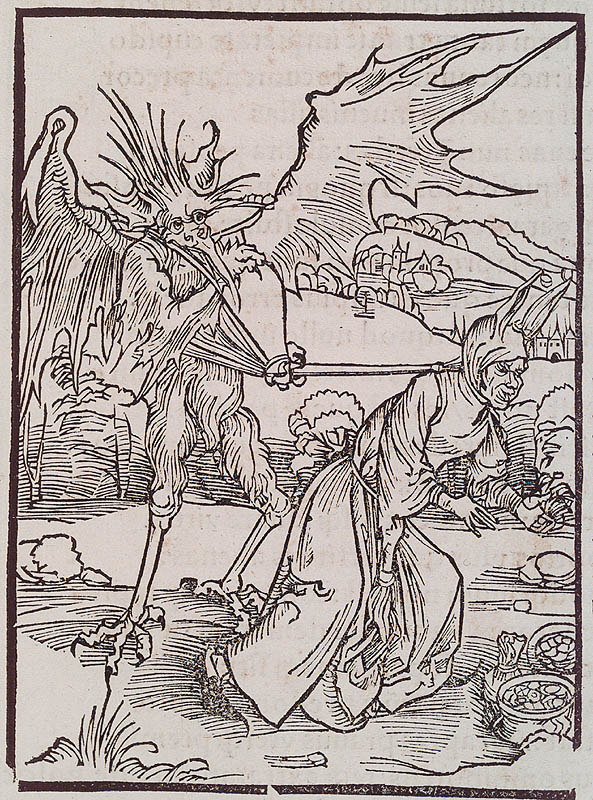
A gandreigh is a riding pole used to fly out astrally to access different realms.  The gandreigh can be a broom, a staff, a stang, or even a wand that the rider uses to send forth a fetch for the astral body to inhabit.

Nigel Jackson writes:
"The stick is the Gandra which is both the magic wand and stick that straddle the Witch of the North. It is a variant of the classic broom or forked stick of witches in Europe. The armies of the night-flying creatures on sticks are called "the gandreigh" in Old Norse. This applies to the flight of witches and the dead ghost hunting Wild."
The gandreigh is not used for physical flight through consensus reality, rather it acts as a world tree by which we can access levels of being through "flying" (or climbing) up and down the pole.

In our tradition the world tree is symbolized by the Spiral Castle, although the stang, staff, or broom is a personal tool which acts as an expression of this energy.  It is the witches most personal tool and is usually destroyed upon a witch's death or given as a kuthun.

Monday, October 24, 2011

The Stang on the Hill (or, The World Tree, or the Spiral Castle)

The Spiral Castle Tradition doesn't actively work with a "world tree" image, per se. That is to say, we don't use the image of a tree to serve the purpose of what the World Tree does in the cultures in which a World Tree is found. However, both our Spiral Castle and our stang upon the ancestral mound (which sits in the middle of the physical space of the compass as we work magic), serve exactly the same purpose, as I believe you will see.

Background and Purpose of the World Tree

The mythology and function of the World Tree seems to be a universal theme in cultures all over the world. References to a World Tree (or Cosmic Tree, Tree of Life, etc.) can be found in the Scandinavian, Finnish, Baltic, Hindu, Shinto, Native American, Mayan, Siberian, Hebrew, Christian, Egyptian, Mediterranean, Byzantine and Celtic spiritual beliefs and practices (to name only a few – the most easily discovered).

The World Tree takes many forms, extends in to many realms, is associated with many animals, but essentially has the same function in each culture. It always, no matter which version of the world tree is being described, connects the realms of existence in a sort of pathway that is (or is a symbol of) the act of creation. Through it, communication and the gaining of knowledge is possible. It is a symbol of both the macrocosm (the universe) and the microcosm (the person).  It is infinitely complex and surprisingly simple.

Connecting the Realms
   
The World Tree connects the realms of existence as they are seen and numbered according to a particular culture. The most common representation of this seems to be the idea of three realms (sometimes being divided into three sections). The Upper, Middle and Lower Realms – usually described as the heavens, Earth and the Underworld; or the Land of the Gods, the Land of Men and the Land of the Dead.

Communication/Messages

Many of the Gods receive messages from animal or spirit beings who travel up and down the tree. Likewise, shamans and priest/esses the world over are said to have the ability to climb the tree to gain the knowledge/wisdom of the other realms and to communicate with both Deity and the dead. This allows them, then, to bring back the advice or wishes of the spirits that guard and protect human life. Indeed, one of the shaman’s or priest’s responsibilities has always been to know the wishes of Deity (in whatever form it takes) and to communicate those wishes and wisdoms to the people.

Consciousness Unit

There is a body of evidence that suggests that the World Tree is a depiction of the “Consciousness Unit” (or CU) – sometimes also called the Collective Unconscious (though I think that is a misnomer since so many spiritual seekers are, in fact, conscious of it). Those who have been trained in out-of-body, meditative and astral techniques have all witnessed a similar structure that can be described as a tree. However, in some cultures, it was described as a mountain (hill, mound, Tor) or a tent (or in our case, a castle).

It is generally seen as nested spheres of energy or consciousness – one structure that houses several others, which house yet more. Although the people who saw it were all likely to have seen exactly the same structure, they used different words to describe it when they were once again in the physical world. This, of course, would all be based on cultural and linguistic limitations and understandings. The most universal description is that of a tree.

Priestly Training

In many cultures, there is the pervasive use of the World Tree as a tool for the training and initiation of preists/shamans. Though the ceremonies differ somewhat, many of them involve a time of sacrifice upon the tree. Others require that the initiate climb the tree (either physically, spiritually or both) to seek information or to trace the steps of creation/wisdom. It is, of course, not surprising, then, to think of Odin’s 9 nights on Ygdrassil as a sort of initiatory model – leading to the use of vision quests, the witches’ cradle, and the actual climbing of a tree as part of the priest’s initiatory process. (The Hanged Man in the Tarot could be said to be suspended from the World Tree to seek a new perspective or initiation into greater mysteries.)

Stars and the World Tree

There is a great association between the World Tree and two specific celestial bodies. The first is the North Star (Pole Star). In many cultures, this star is said to be the pin or tack at the top of the World Tree. (It reminds me of the star atop a Christmas tree, though the association would have been much older than Christianity. It was probably a part of the Cabalistic mysteries, and therefore absorbed unwittingly into the Christian mythos. Or, which is more likely, since I have seen no reference to the Pole Star in the Cabalistic World Tree information I found, it was probably assimilated from the older Indo-European practices and beliefs. Perhaps the Yule tree used in so many Germanic tribes was, in fact, an echo to Ygdrassil.)

The other celestial body associated with the World Tree, specifically in Mayan culture, is the Milky Way. Of course, I take some liberty in referring to an entire galaxy as one celestial body, but the idea is understood. In some descriptions, the Milky Way is called the World Tree. In others, it is seen as perpendicular to the World Tree.

In fact, the Mayan calendar is said to spring from the World Tree. It is this same calendar which, with the Mayans’ uncanny mathematical understanding of the “wobble (or precession) of the Earth’s axis, dates the Winter Solstice of 2012 as the point when the next cycle of that same wobble will begin. It is on this date that the North Star, from the Earth’s point of view, will point directly into the center of the Milky Way.

The starry connections to the World Tree are significant for the Tradition at hand, as well. In Robert Cochrane's writings, pay attention to his references to "Caer Ochren." They are in close concert and connection to the statement "I am a Hill," which he follows up with a description of a castle of seven gates, upon a gloomy hill, turning to the elements.


Crosses and Mountains

I am grouping crosses and mountains together because I see them as two similar, perpendicular derivations of the World Tree concept. Mountains, specifically, have been mentioned in several works as other ways of seeing the CU (the thing that the World Tree represents – that is to say “everything.”)

I only go into this idea of perpendicularity because its recurrence seems significant to me. In fact, the World Tree itself is sometimes described as vertical, sometimes as horizontal. Perhaps it is both, in a sense. Or, it could be, as the Cabalists have described it, that there are two different trees that are essentially one World Tree. The Tree of Life, in this line of thought, is vertical, and the Tree of Knowledge is horizontal. (They are depicted as columns running between certain spheres.)

This perpendicular meeting between two poles/columns/pillars is the symbol of a cross. It is balance. It is life hinged on wisdom, and wisdom hinged on life. It is the cross of sacrifice as seen in the Christian mythologies. It is the equilateral cross of the elements in the Celtic cosmology. It is the tree on which Odin hung. Moreover, it is the crossroads at which magic and initiation happen.

Then there is the mountain, whose base is the horizontal axis. The line from the base to the peak is the vertical axis. In some cultures, a specific mountain has been their World Mount. And mountains the world over have been deemed as sacred. In fact, many cultures have created mountains as representations of the concepts embodied within the World Mount/World Tree concept. The Great Pyramid of Egypt is a prime example of this, while the Celtic Tors are examples known to many others. The sacred mountain connects the realms just as the World Tree does. The Torprovides access to the three realms. Medieval witches, too, were said to fly to Bald Mountain at Samhain for their great revel.

 
The Animals of the World Tree


Typically, eagles are said to dwell in the uppermost branches of the World Tree, with other birds living in some of the lower ones. Deer and horses are associated with the trunk of the tree, while snakes are seen twisting around the roots.

Although these images are fairly consistent throughout the various cultures, the Norse Ygdrassil houses all of them, and a few others. Specifically, there is an eagle at the top (which associates the eagle in my mind, then, with the Pole Star). Between the eagle’s eyes perches a hawk. There is a dragon that is twisted among the roots, as well as other snakes and serpents who help him gnaw at those roots. A certain squirrel delivers messages between the Dragon and the Eagle, who are feuding. Other bringers of messages associated with Ygdrassil are the ravens who bring messages to Odin of Midgard and Niflheim (the middle and lower realms). There are also stags, a goat, and a hart who roam the branches and trunk and eat the leaves of the tree.

Interestingly, the name of the tree means “Odin’s Horse” (because he rode it to attain enlightenment). This is interesting because so many of the other World Tree mythologies have sacred kings or gods tethering their horses to the trunk of the World Tree. Furthermore, the word Cabala is derived from the same Latin word as the word for horse (equus). (I know it seems like a stretch, but the Spanish word for horse is caballo, and the Italian is cavallo,which certainly show the progression of the word into derivations.) Therefore, horses are largely associated with the World Tree. So much so that at least one version of the World Tree is named as a sort of horse -- a means in itself of "traveling."

Stang-Rider

Just as a priest or shaman is trained to ride the tree, so is a witch or anyone of us of sorcerous ilk trained to ride the stang, walk through the Spiral Castle, fly on the broom. The broom, after all, is fashioned from a forked staff -- a stang at its heart! These tools are aids in achieving soul flight, in fully experiencing the world around and within us, before and behind us, below and above us. In a great many ways, they are all the same tool, just fashioned in a different package.

Sunday, August 21, 2011

The Fetch and Flight

Witches do three things, and do them well.  Firstly, witches do witchcraft. This is the action of casting spells, conjure, hoodoo, cunning, rootwork, powwow, folk-magic, or what-have-you.  Secondly, witches honor the horned Witch Father, and the Goddess of life and death.  There are many names and expressions of these energies, but they are common to all witches.  Finally, witches fly.  How witches fly is a matter of debate.  Flying is not an act of levitation, but it is a means of travel.  Flying is simply the act of sending your astral body (or, as we call it, the black soul) out to travel through the realms.

There are many ways to fly.  One may use drumming, chanting, or dancing to achieve an altered state of consciousness. Warricking and stropping are another traditional way to "get out of yourself".  Also, the use of certain herbs and compounds, such as hallucinogens, flying oinments, alcohol, and herbal incenses, can produce or heighten the effect of flight.

Although flight can be achieved through the simple projection of the astral body, witches have several traditional techniques for assisting the black soul while it is mobile.  These include use of a gandreigh, or riding pole, such as a broom, a stang, a staff, or a hobby horse, and the construction of a fetch.

A fetch is an etheric construct that the witch projects herself into for the purpose of astral flight.  This construct can take the form of her own body, or that of a totemic spirit.  Totemic spirits are desirable for this work because the witch already has a unique bond with that creature, and therefore can easily assimilate herself into the new etheric body.

The fetch can be thought of as an inanimate shell of energy waiting for your own astral self to inhabit and enliven it.  It can travel through all the realms as astral space, and can be seen in the physical realm by those that are inclined to mediumship.

Just as with an incorporeal familiar spirit, it is wise to create a kind of "home" for the etheric construct
And I shall go into a hare...
of the fetch to inhabit when not in use as a vessel for the astral body.  A crystal, a statue of the animal, or a spirit bottle are all good physical anchors for this energy.

As with all things, the more you practice, work with, and feed this construct, the more effective it will be when you wish to use it. If you wish to stop working with a particular fetch, simply reabsorb its energy into yourself and deconsecrate or destroy the fetch's house.  This should, however, be avoided if at all possible, as fetches build up numen with time and use, and can become quite powerful in their own right.  They are, in fact, a kind of egregore purposed as a vessel for your own use.

You may wish to cue your transformation from astral body to fetch construct to the use of a charm, such as the Scottish witch Isobel Gowdie did as recorded in the record of her trial in 1662.

I shall go into a hare,
With sorrow and sych and meickle care;
And I shall go in the Devil's name,
Ay while I come home again.

(sych: such; meickle: great) To change back, she would say:

Hare, hare, God send thee care.
I am in a hare's likeness now,
But I shall be in a woman's likeness even now.


Listen below to a modern interpretation of the Gowdie shifter's chant by by Northumbrian folk singer and storyteller Sedayne (Sean Breadin).

Saturday, August 6, 2011

The Witches' Stang

The stang is the central tool and main altar of our tradition. A stang, in its most basic form is simply a forked stick set with its long end into the ground. It acts as an axis on which magic can turn, and as a pole that can be "ridden" by the shaman or witch into different realms. Its forks represent the horns of the Witch Lord.

The stang entered modern Craft by the hand of Robert Cochrane, who called it as "sacred to the People as the Crucifix is to the Christians."  I've written about Cochrane's use of the stang in my July 2011 post on Treading the Mill.

The stang is sometimes represented by a iron-tined pitchfork or a pole with the skull of a horned beast on it. Often in these configurations there will be a candle or torch lit between the two horns or tines, in the style of the icon of Baphomet, or as is shown in this woodcut from 1594 of a sabbat at Treves.

The Horned God with the cunning light between his horns.

Any wood is suitable for use as a stang, although ash, with its connections to Yggdrasill, the tree on which Odin was hung shaman-like for nine days, is a popular choice. Our own stang is based on Him that we honor as the Witch Lord, T'Qain. It is therefore represented by a ram's skull.  It represents both His presence and the Spiral Castle.

Although not as popular as motif as, say, riding a broomstick, there are many examples of witches using the stang to fly in early woodcuts as is shown by the examples below.

Using the stang to carry a cauldron while riding backwards on a goat. It has all the things. ;)

A masked family flies out on their stang.

A witch and her demonic familiar fly to the clouds on a stang.

The stang has antecedents in the Yggdrasill of Norse lore, the Poteau Mitan of Haitian Voudon, and the ascending-pole birch tree of the Yakut shamans.  It is both a world-pillar on which the cosmos (represented by the witches compass) turns and a gandreigh.

Admit it. You want to try out magic with a stang.

For more information I suggest reading the writings of Robert Cochrane, and Nigel Jackson and exploring the links below.

How to Use a Stang
A Special One, But Still a Pole
Posts Labeled "Stang" from This Blog

Tuesday, July 19, 2011

The Staff

Note that this is a discussion of the generic witch's staff. It is not to be confused with the Blackthorn Staff or the Distaff, both of which are different tools with distinct characteristics. These tools will be discussed in future entries.

Witches' staves
The staff is a straight stave cut from any wood.  It can be of any length, usually ranging somewhere from waist height to just slightly taller than full height of the witch who will be using it.  There is no specific type of tree that is chosen for a staff, rather, the witch will wander the woods at will, communing with the spirits there, and feeling for a young tree that is willing to give its life for the creation of a magical tool.

You may already have a piece of dead-fall or a walking stick which you wish to use for a staff.  If you do not, you should seek for a young tree in a copse of other trees.  This will encourage the tree to be straight, and will leave less impact on the forest. Raise the power and send it coursing into the potential tree. Tell the tree in your own words what you are seeking and then ask it if it is willing to give itself to become your staff. The tree must give consent before proceeding.

You will need to make an offering to the tree.  The traditional offering is, as always, a piece of silver.  Birdseed and fertilizer are also good choices, especially if you choose to make ongoing offerings to the tree over a course of time.  When you are ready to harvest your staff take the offerings to your tree along with a mundane handsaw that has been consecrated for this purpose, the shelg, bottled water, and a first aid kit.

Confirm a final time that the tree agrees and desires to be your working tool.  Lay a compass to hold the energy in the grove. Make your offerings to the grove.  Ask the tree to send its life force down into its roots. Cut the tree down with the handsaw, concentrating on the purpose of your task.

When the tree falls use the shelg to cut your palms.  Hold the tree and let your blood and spirit fuse with the wood. Consecrate the wood in the name of any deities and powers that you wish.  Clean your wounds and bandage them well. Use the handsaw to cut your staff to the length you desire.  Cut any “scrap” wood from the tree that you wish to use for besom handles, wands, etc.  Scatter the remaining wood and branches throughout the grove, leaving as little trace of your work as possible.

If you are working from a piece of dead-fall wood be certain that it has not been compromised by rot or insects, then proceed to blood the wood just as you would with a newly felled tree.

You may choose to adorn your staff however you wish.  You may remove the bark, or leave it on.  Your staff can be as elaborate or as simple as you like, and it may evolve in style and decoration as you grow and change in the Craft.  Some witches choose to keep their crane bag hanging from their staff.

One thing that must be done before the staff is used formally in ritual is the shodding of the staff.  You may choose to do this during a consecration ritual for the staff.  To shod the staff you need only to drive a nail up into the bottom end of the staff.  This seals the staff as a weapon in the name of Qayin, and creates it as a properly iron shod steed.

The staff may now be used to cut the boundary of the river of life and death when laying the compass.  It can also be ridden both as a gandreigh and a tool for treading the mill.

The staff is a truly personal tool of a witch. It is not passed down as a kuthun to students or family.  It is best if the staff is destroyed upon a witch's passing, or that it is given back to earth, water, or fire with the witch's remains.
Related Posts Plugin for WordPress, Blogger...