Thursday, September 27, 2012

The Descent of the Goddess

In Ancient times our Lord, the Horned One, was, as he still is, the Consoler and the Comforter. But men knew him as the dread Lord of Shadows. Lonely, stern and just.

Now our Lady the Goddess had never loved, but she would solve all the Mysteries. Even the mystery of Death, and so she journeyed to the Underworld.

The Guardians of the Portal challenged her thus: Strip off thy garments, lay aside thy jewels, for naught mayest thou bring with thee into this our land.

So she laid down her garments and her jewels, and was bound, as are all who enter the Realms of Death the Mighty One.

Such was her beauty, that Death himself knelt and kissed her feet, saying: Blessed be thy feet, that have brought thee in these ways. Abide with me, but let me place my cold hand on thy heart.

She replied: I love thee not. Why dost thou cause all things that I love and take delight in to fade and die?

Death replied: Lady, 'tis age and fate, against which I am helpless. Age causes all things to wither; but when men die at the end of time, I give them rest and peace, and strength so that they may return. But thou! Thou art lovely. Return not; abide with me!

But she answered: I love thee not!

Then said Death: An thou receivest not my hand upon thy heart, thou must kneel to Death's scourge.

It is fate - better so, She said. And she knelt, and Death scourged her tenderly. And she cried: I feel the pangs of love!

And Death raised her, and said: Blessed be! And he gave her the Fivefold kiss, saying: Thus only mayest thou attain to joy and knowledge.

And he taught her all his Mysteries, and they loved and were one. And she taught him her mystery of the sacred cup which is the cauldron of rebirth. And he gave her the necklace which is the circle of rebirth and taught her all the Magics.

For there are three great events in the life of man: Love, Death and Resurrection in the new body; and Magic controls them all.

For to fulfill love you must return again at the same time and place as the loved one, and you must meet, and know, and remember, and love them again.

But to be reborn, you must die and be made ready for a new body; and to die, you must be born; and without love, you may not be born; and this is all the Magics.

Traditional, from the Gardnerian Book of Shadows.

Note: although our tradition is not Gardnerian, we are informed by it, among other things.  This piece of liturgy is not a part of our own tradition, but is appropriate to this season and the concept of the Lord of Death as a beneficent being.

Tuesday, September 25, 2012

Autumn Equinox 2012 Photos

Autumn Equinox 2012 altar.  At this Sabbat we celebrate the Grail Queen of the Silver Castle -- Castle Perilous -- as Cerridwen-Babalon. We drink deeply of her bloody cup, and rejoice in the coming of the Season of the Witch.

Altar detail.  The lovely stone sphere is Chimera Stone (tm).  The large gold and scarlet chalice is the Cup of Babalon, used each year during the Feast of the Beast at the Babalon Rising Festival.
At the base of the altar are L-R: coven chalices, the Spiral Castle, Tubal Cain & his anvil, coven member totems, salt water, sterile lancets, and our Grimoire.
The Housle Song
To the tune of Greensleeves

To Housle now we walk the wheel
We kill tonight the blood red meal
A leftward tread of magic's mill
To feed the Gods and work our Will.

Red, red is the wine we drink
Red, red are the cords we wear
Red, red is the Blood of God
And red is the shade of the Housle.

Monday, June 25, 2012

Sabbat Wine, Flying Ointment & Enthogens

Entheogen is a Greek derived word that means "generating the divine within." An entheogen, therefore, is a psychoactive substance that is used in a religious, spiritual or shamanic context. Traditional Witches have used entheogens of several types for centuries, as recorded in the lore of mythology, in the records of the trials and persecutions, and in the regional indigenous shamanic practices  that have been assimilated into the Craft various locales.

Among the most commonly used and widely known entheogens in European and American Witchcraft practice are Sabbat Wine and Flying Ointment. These are the two on which we'll focus our attentions in this exploration. (While there are many and varied regional entheogens that have found their way into Craft practice in some form or another, they are just too numerous for me to mention here. Furthermore, I really don't feel qualified to speak on them since I'm very inexperienced with them.)


Sabbat Wine

Wine, just as it is, constitutes a powerful entheogen. The Dying and Resurrected God is embodied int he wine in the form of Dionysos -- and in Jesus, for that matter, whose symbolism and mythology associates him with the wine. Dionysos, though, is the "Twice Born" God of the Vine, and his cup is the offering of ecstasy and madness. "I am the vine," he says, and he offers insight into death and rebirth, despair and joy.

Many Witches drink wine -- either a little or a lot -- as a part of their Sabbat rites no matter what. In American Folkloric Witchcraft, we include Sabbat Wine for two separate and distinct purposes -- and the wine is different depending on that purpose.

If we are celebrating the Housle as we usually do within the regular course of ritual, we will sacrifice a cup of red wine. It is the shed blood of the Red Meal that is the Housle.  In this instance, we don't add anything to the wine because we don't need any additional entheogenic effect.


If, however, we are doing trance work, flying out, seiding, or otherwise seeking an altered state of consciousness, we might prepare our special Sabbat Wine (vinum sabbati). We also prepare this Sabbat Wine for initiations. In our case, the vinum sabbati is a local sweet red wine (Oliver Soft Red) in which mugwort and lemongrass have been mulled. After straining the herbs, we add local honey to sweeten the mix and cut the bitterness of the mugwort. Both mugwort and lemongrass have gentle psychoactive properties.

It's interesting to note that the term "vinum sabbati" has actually been associated with flying ointment, or the witches' salve, which is the other major entheogen of witchcraft. In fact, Nigel Jackson said flying ointment was "the black wine of owls."

Flying Ointment

This greasy, trance-inducing substance was traditionally made of hallucinogenic (and often fatal) herbs that had been boiled in pig fat and then strained. It was called "green salve" or "witches' ointment" and it some of the stock ingredients (solinicaeds) caused a "flying" sensation as the hallucination began -- hence the popular image of the flying witch.

Great care had to be taken in preparing this ointment, though. Traditional ingredients included such components as henbane, monkshood, deadly nightshade, belladonna, hemlock, and mandrake -- all lethal in too large a dose. In some cases, that does could be quite small. One witch learned from another how to properly prepare the salve and how to administer it to herself, and I'm sure it was still "At your own risk, sister."

I'm simply not a brave enough woman to fool around with these poisons. So, I looked to some of the other traditional ingredients in the old flying ointments -- the ingredients that wouldn't cause a person to exsanguinate from their skin, for example. (Belladonna does that. It's the key ingredient in rat poison.) Cinquefoil and Balm of Gilead made the cut from the old recipes. Then, I gathered together herbs known for trance and vision work -- many of which I'd already used successfully. Mugwort, Dittany of Crete, lemongrass, clary sage, wormwood, rue.

I use vegetable shortening as the fat, and I add benzoin powder and vitamin E for preservation. None of the last is traditional in any way, but I want it to last and not get funky.

Our coven uses this mix a fair amount. We fly out at just about every Sabbat. Does my blend make you trip? No. Does it help you fly? Oh yeah. Everybody whose used it add reported back has shared positive results. At this point, that's been a fair few people, since we do sell this in our Etsy shop.

Saturday, June 16, 2012

Castle of Stone

Castell Dinas Bran
4-Cornered Castle
Mont & Bailey
Top open to the sky
Seige-place
Warriors' Fort (training, defense, offense, strategy)
Hillfort (castillo)
Not a place of luxury
Guarded by legged creatures (crawlers, walkers)
Home of Cernunnos
Summer Solstice
Noon
Mysteries of Rebirth


The castles of our system are based on Grail Lore, but they also have representations in the none world. These castles are symbolic of the energies inherent in their names and attributed to them by myth and legend. In the Arthurian cycle, the knights journey to seven castles, but most mythographers interpret this imram as an Otherworldly voyage, akin to the shaman's journey into the soul, using the World Tree as a ladder. Robert Graves, in The White Goddess, indicates that each of the seven castles is synonymous with the Spiral Castle, Caer Sidhe (or Caer Arianrhod).

Graves' interpretation makes good sense to us. Each of the castles is so intimately connected in symbolism and meaning, and it is impossible to separate any one of them from gestalt of Caer Sidhe. It is based on this concept that, while we talk about the castles as separate places, we ultimately view them each as a tower or turret on the great Spiral Castle.

The Castle of Stone is the home of Cernunnos, in our system. He is the keeper of the castle and the guardian of its treasure, the Stone Bowl. Cernunnos is honored at Summer Solstice as the Oak King, and the totems present in his time of honor are the Oak, Stag, and Robin.


One of the names of the Castle of Stone is the "4-cornered castle," in Welsh Caer Bannawg. This name became Carbonic or Carbonak later. Graves suggests that this castle is in fact a burial place like a kristvaen (which is formed from four stone slabs that make a stone box). It has also been suggested that "4-cornered" refers to the castle rotating four times, which certainly ties it symbolically to the Spiral Castle.

Carbonak is an important locale in Grail myth, as it is the home of Elaine (the Grail Maiden, wife of Lancelot, and mother of Galahad). It is here that the Grail is revealed in the saga, when Elaine shows it to Lancelot.

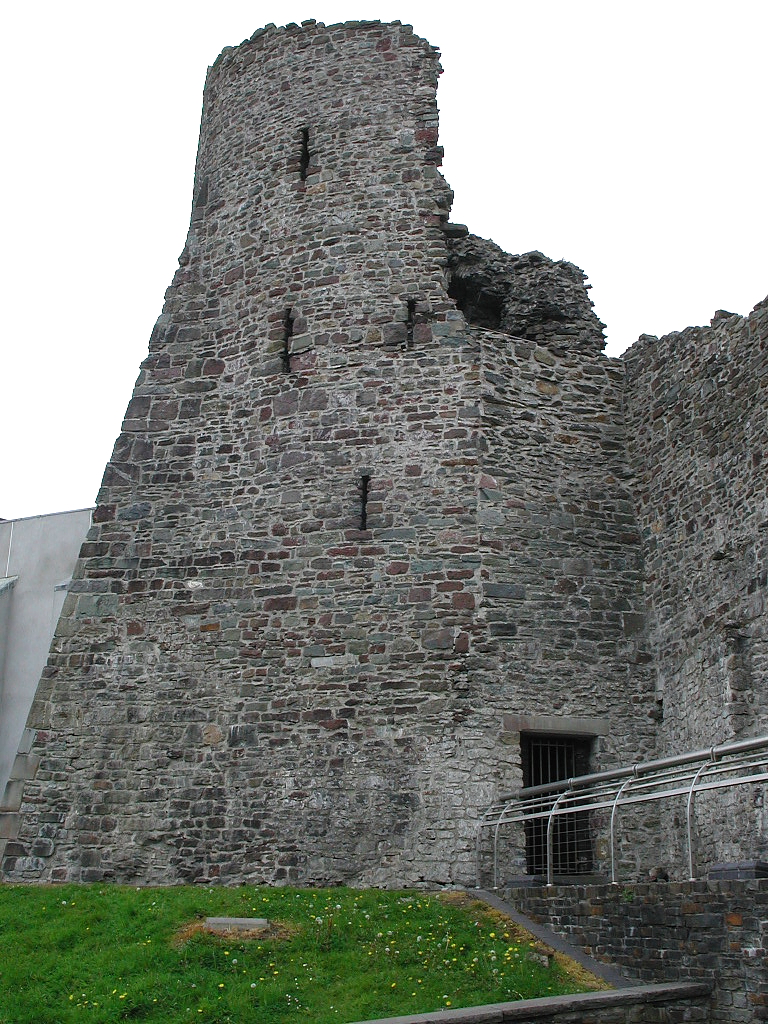
Carmarthen -- a 4-cornered castle
The Old French version of this name is cor beneoit, meaning both 'blessed horn' (alluding to the Grail as a horn of plenty) and 'blessed body' (referring to the Grail as a Eucharistic vessel). The reference to horn also works nicely as an allusion to the Horned God of this keep.

Carbonak is also heavily associated with ravens and with Bran the Blessed. Corbin, which the castle is called in certain parts of the myth, is the Old French word for "raven." Bran means raven in Welsh and Cornish. An extent hill-fort in Penwith, Cornwall is associated with Carbonak, and it is called Caer Bran. The Brythonic possessive version of this name is Kernowek. Castell Dinas Bran ("Castle of the City of Crows") in Wales is assumed by scholars to be the most likely site of Carbonak, however. Bran is inescapably tied to the Grail mythologies in the sense that he, too, went on a voyage in search of a sacred vessel, The Cauldron of Rebirth. Like the Grail-King, he was pierced by a spear and the land suffered until he was healed. Bran is honored and remembered in the Arthurian cycle as Brons, one of Arthur's knights, the son-in-law of Joseph of Arimehtea (who, of course, is said to have brought the grail -- as cup of Christ -- into Celtic lands).


The Stone Castle is no palace, no place of luxury or entertainment. It is a fortress, a place of training and of siege. It is the Vault of the Mysteries. It is a place of safety, and it is a storehouse. It is a seat of power and is built at a site of strength (or one with protective needs).

Several castles and forts spring to mind when envisioning Caer Bannawg for oneself. The Krak de Chevaliers, for instance, is a wonderful example of a medieval fortress. It is a "Mont & Bailey" castle, and it is practically impenetrable. It is functional and foreboding, and it takes very little manpower to defend it.

Cliffords Tower (in York), the Alamo (San Anotnio, TX), and the Castillo del San Marcos (St. Augustine, FL) are all great examples of the Stone Castle.

Krak de Chevaliers

Sunday, June 3, 2012

Tis June!

Friends, we have made it though one round of the Compass together on this blog!  It is festival season here for Laurelei and I and that means that we might not be posting as much as usual for a while.  It also means that Blade and Broom Botanica will be on the road, and our online store will be taking a temporary break.

Here are some of our articles from last June to keep you entertained until we return.

June Totems:
Stag
Oak
Robin

The Sabbats: 
Midsummer

The Oak King:
Faces of the Oak King
Meditation of Visiting the Oak King

You can learn more about our tradition's Wheel of the Year here.
Related Posts Plugin for WordPress, Blogger...